
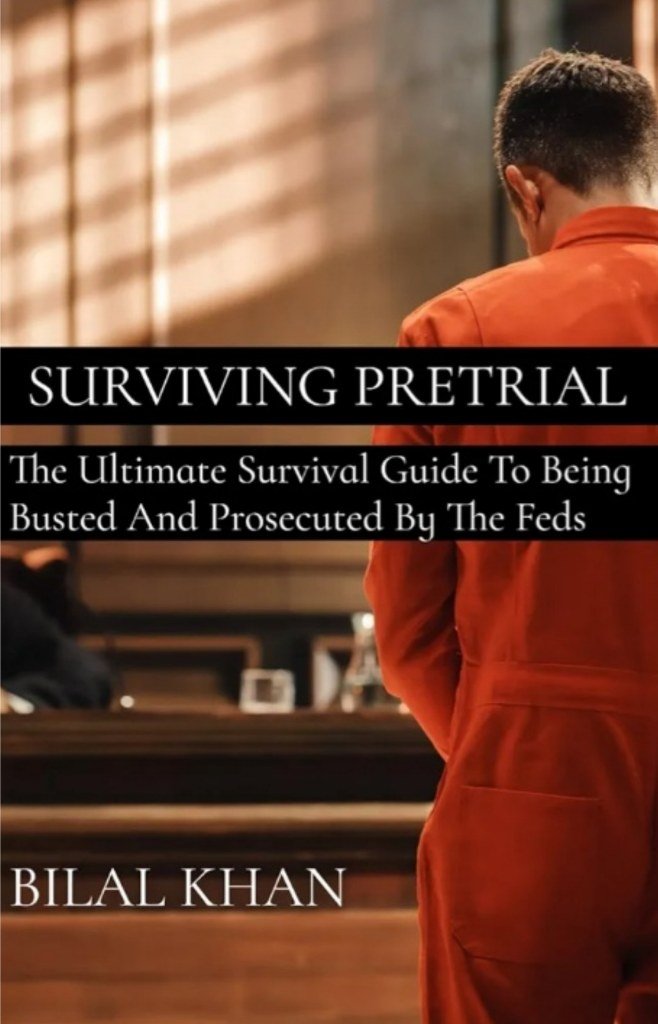
Every question in this evaluation is covered in full detail in Surviving Pretrial — written for the defendant and the family navigating the federal system for the first time.
Order on Amazon →Here's how to use it.
First — take a breath. Nothing on this page will rush you, ask you for money, or ask who you are.
I built it around one idea: you shouldn't have to know the right legal term to get the right answer. Everything here starts from where you actually are, not from vocabulary you were never taught.
Start with Evaluate My Situation on the left. A few questions, about ninety seconds, and you get a written plan for your case — where things stand, what happens next, the red flags to watch for, and the questions to ask your attorney. Nothing you type is saved or sent anywhere. It lives in your browser until you print it, so print or download it before you close the window.
If a plea deal is on the table, read Before the Plea first. Most federal cases end in a plea, and most people sign one without being told what they're giving up.
The calculators do the math the government has already done — your guideline range, the security level the BOP is likely to assign, First Step Act time credits, and what people charged like this actually received. They're estimates, not promises. But they turn guessing into numbers you can take to your lawyer, and the guideline sheets print out to bring to a visit.
Read what helps. Print what you need. Ignore the rest. It will all still be here when you come back.
Awaiting Situation Input
Select your situation from the dispatch panel on the left.
Answer six quick questions. We build a situation-specific action plan you can print and mail inside — names, contacts, red flags, a cover page, and a journal section for documenting everything. Takes 90 seconds. Free.
You were just arrested. Here's what you need to know right now.
The next 24–48 hours are the most critical. These answers will get you through them.
Here's what I want you to hear before anything else: you are still the same person you were yesterday. The government moving against you does not change that. Now — here's what actually matters in the next 24 hours.
Stop talking. Not to police. Not to agents. Not to other inmates. Nothing, to no one, about the case. This is the single most important thing you can do right now. Agents are patient, friendly, and trained for exactly this moment. "We just want to clear a few things up" is not an offer to help you — it is an invitation to build the government's case for them.
Say exactly this:"I am going to remain silent. I want a lawyer." Then stop. Not one more word. Say exactly this:"I am going to remain silent. I want a lawyer." Then stop. Not one more word.
Yes. Regardless of your finances, you will have an attorney. If you cannot afford one, a federal public defender will be appointed at your first court appearance — usually within 24 hours. Do not panic about this. Court-appointed federal defenders are often deeply experienced. The question is not whether you will have a lawyer, but how well you work with that lawyer once you do.
Within 24–48 hours: your initial appearance — a brief court hearing where you are told the charges and advised of your rights. Shortly after: the detention hearing, where a judge decides whether you are released or held in custody while the case proceeds. The detention hearing is one of the most important early moments in the case. Preparation for it matters.
Every call from a detention facility is recorded and available to prosecutors. The rule is absolute: do not discuss the facts of the case on any jail line. Not with your family. Not with friends. Not with anyone. The only exception is your attorney — and that line must be properly set up as a legal call. On every other call: where you are, how you're doing, and logistics. Nothing about the case.
Someone close to you is terrified right now and getting no answers — this site was built for them too. On your first call, tell them where you are and that you're okay. That's the whole conversation. They can find practical guidance here for every step they need to take, starting with finding you and getting money on your books.
You made it through the first read. That matters. Now — when you're ready — go deeper. The book covers every step from this exact moment through sentencing, in language that doesn't require a law degree.
Surviving Pretrial. The full field guide.
Written by someone who went through every stage of a federal case. Covers arrest through sentencing in plain language. Many families read the first chapter the night of the arrest.
See the Book Free ArticlesSomeone you love was just arrested. Here's how to find them and help.
The first hours feel like chaos. They aren't — there's a process, and here's how to work it.
I know what this feels like. That mix of terror and helplessness and not knowing who to call or whether you're already making a mistake by just existing. You're not. You found this page, and that's the right move.
Start with the local jail or police station — call them directly. It can take hours for someone to be processed into the system. If you're told they aren't there, don't panic. Wait and call back. If this is a federal case, go to pacer.uscourts.gov and create a free account. Use the Case Locator to search by name. The docket will show the charges, the next hearing, and who has been assigned as the attorney — call that attorney first.
Once you know where they are, ask the facility how to add money to their commissary account. This covers the basics: soap, food, stamps, phone time. An initial deposit of $100–$150 gets them through the first week or two. The facility will tell you which payment service they use — common ones are JPay and GTL/ViaPath. It matters more than you might think.
Accept the call. Hear their voice. Tell them you love them. Then: do not discuss any facts of the case on that line. Every jail call is recorded and available to prosecutors. Keep it to where they are, how they're doing, and what they need logistically. Everything about the case stays off that line. Save all of it for the attorney.
The detention hearing happens within a few days of arrest. A judge decides whether your loved one is released while the case proceeds or stays in custody. In federal cases, many people remain in custody through the entire case. It is one of the most important early moments, and the attorney should be actively preparing for it. If they're not, ask why.
The two ways families most often cause inadvertent harm: talking too openly on recorded lines, and posting about the case on social media. Both can reach prosecutors. What you can do right now: be present, stay calm, gather practical information, and let the attorney do the legal work. Your stability is genuinely part of their defense.
You didn't ask for this. Neither did they. But you're here, getting answers, and that's exactly what they need you to be doing right now.
Surviving Pretrial. Written for both of you.
Covers the full pretrial process — from the night of arrest through sentencing. Written in language you don't need a law degree to understand.
See the Book Free ArticlesCharges may be coming. This is when you have the most options.
Before arrest is the stage where the right moves can change the entire trajectory.
This waiting stage — where nothing has been charged but the signs are there — is actually when you have the most control. The government hasn't locked all its options yet. The decisions made now, before arrest, can shape everything that comes after.
No. Nobody does — not the person under investigation, not family members, not witnesses. An agent can ask you anything they want; you can decline to answer everything. The common trap is the "friendly conversation" — they are not there to help you, they are there to build a case.
Say exactly this:"I appreciate your time, but I'm not going to answer any questions without speaking to an attorney first." Then stop.A target letter is a written notice from the U.S. Attorney's office that you are a "target" of a federal grand jury investigation. It is not a charge. It is a warning, and it is an opportunity. If you receive one, contact a federal criminal defense attorney immediately before calling the number on the letter or responding in any way.
A grand jury subpoena is a court order requiring you to appear before a grand jury and testify. You must appear — but appearing does not mean answering every question. You can invoke your Fifth Amendment right against self-incrimination in response to specific questions. An attorney must be involved before you comply with a grand jury subpoena.
Yes — unequivocally. Having an attorney in place before arrest can meaningfully change the outcome. They can communicate with the government on your behalf, potentially negotiate a voluntary surrender, get involved before charges are finalized. Waiting until after arrest means the attorney is always catching up.
If federal agents arrive: you do not have to let them in without a warrant. If they have one, comply physically but do not answer questions. Step outside if possible. Do not argue, do not explain, do not try to help. Call an attorney the moment they leave — or during, if possible.
Say exactly this:"I'm not going to answer any questions without an attorney. I do not consent to a search." Then stay quiet.The people who do best in federal cases are the ones who got good information early and stopped talking early. You're already doing one of those things right now.
Surviving Pretrial. Before and after arrest.
The book covers everything from the investigation stage through sentencing — including how to choose an attorney, what to expect at every hearing.
See the Book Free ArticlesThe arrest is done. Now you need a map of what comes next.
The initial shock is settling. Here's how the system actually works from here.
The panic of the first days has settled into something harder in some ways — a long stretch of uncertainty where you don't know what's coming or when. Let me give you a map.
Federal cases move slowly. After the initial stages, the government completes its investigation, a grand jury returns an indictment (or the defendant agrees to a plea by information), and then comes discovery — the government sharing its evidence. Pre-trial motions, negotiations, and eventually a plea agreement or trial follow. Most federal cases take six months to two years. The waiting is hard. It is also normal.
The Presentence Report — the PSR — is prepared by a U.S. Probation Officer after a conviction or plea and submitted to the judge before sentencing. It contains the guidelines calculation, the government's version of the offense, the defendant's full background. The judge reads it. Errors in the PSR, if unchallenged, become the record. Your attorney should review every line and object in writing to anything inaccurate.
A plea agreement is a contract between the defendant and the government. The defendant agrees to plead guilty to specific charges; the government agrees to specific terms. More than 97% of federal convictions come from guilty pleas. What matters most before signing: understanding exactly what is being admitted to in the factual basis, because those admissions drive the sentencing guidelines calculation.
Yes. The moment before a plea is signed is one of the last opportunities to shape the outcome — and most people miss it. Sentencing is built into the plea. The facts admitted in the factual basis, the guidelines range agreed to, the cooperation structure — all of it is locked in when the plea is signed. That's why sentencing preparation belongs before the plea, not after.
Doug Passon is a federal attorney with 30 years of experience — 12 of them inside the Federal Public Defender's office — and the nationally recognized pioneer in video sentencing advocacy. His work is not just for the sentencing hearing. He can be instrumental in shaping what the plea itself looks like. I recommend calling him before any plea agreement is signed, even if you have another attorney. His number is (800) 846-3909 — dougpassonlaw.com.
Full disclosure: Doug was my attorney, and we became friends after he showed himself to be a lawyer who fights hard, doesn't judge his clients, and advances their story.
Red flags: minimal contact, no explanation of strategy, pressure to plead quickly without explanation. Signs of strength: regular communication, a clear and evolving strategy, meaningful engagement with the PSR. If your gut says something is wrong, it is worth getting a second opinion. A bad attorney in a federal case can cost years of someone's life.
Most federal cases take six months to two years from arrest to sentencing — often longer for complex cases. This is a marathon, not a sprint. Pacing yourself, and your family, is part of surviving it. The people who hold up best are the ones who understand the timeline and don't try to sprint it.
This is one of the most important questions families face, and the conventional answer — "hire the best attorney you can afford" — is often wrong. If your total available budget is $30,000 or less, a skilled public defender with well-funded ancillary services will frequently outperform a private attorney at that price point.
Here's why: at that budget level, a private attorney has already consumed most of your money before they can pay for the things that actually move the needle — investigators, expert witnesses, psychological evaluations, sentencing mitigation specialists. Public defenders are experienced and capable. What they lack is resources. And resources, in a federal case, are what you can actually provide.
Consider "gifting" services directly to the defense: a Sentencing Stats judge analysis report, a professional sentencing mitigation video through Doug Passon Law, or a private investigator to develop contested facts. The Criminal Justice Act can also fund certain experts — your attorney can petition the court, though approval is at the judge's discretion.
I watched a friend's family spend $5,000 on a private investigator while he was represented by a court-appointed attorney known as "pretty bad." The investigator found evidence that helped set him free. The public defender wasn't a bad lawyer — she just finally had real information to work with.
Call early: Contact Doug Passon Law (800) 846-3909 and Sentencing Stats (855) 778-8654. Both work directly with public defenders and can be engaged independently of who holds the representation.Understanding how the system actually works is the only thing that makes the waiting manageable. Knowledge is not power in the abstract — it is the difference between fear and strategy.
Surviving Pretrial. The full picture.
Covers the PSR, the plea agreement, the sentencing hearing, attorney evaluation, and everything in between — written from the inside.
See the Book Free ArticlesThe jail isn't caring for your loved one. Here's what you can do about it.
Facilities don't fix problems they don't know are being documented. Start a paper trail today.
This is one of the most frustrating things a family can face — your person is somewhere you can't get to them, and the people responsible aren't doing their job. Let me tell you what you can actually do, starting today.
Federal detention facilities are legally required to provide: adequate food meeting basic nutritional standards, access to medical care for chronic conditions and emergencies, safe housing free from known threats or abuse, basic hygiene and sanitation, and access to an attorney. They are not required to be comfortable. But they are required to provide health and safety — and when they don't, that is a legal issue.
Find the facility's direct number through the BOP inmate locator at bop.gov. Ask to speak with the case manager (general issues) or medical department (health concerns). Then document everything: date and time you called, who you spoke with, exactly what they said. A paper trail matters if this escalates.
The attorney has legal access and standing that you don't. They can communicate directly with facility staff, request urgent medical reviews, document conditions for the court record, and file emergency motions if the situation rises to a constitutional level. Facility condition problems are part of their job, not a burden.
For BOP facilities, there is a formal complaint process: the inmate files a BP-8 (informal resolution with staff), then a BP-9 to the warden, then a BP-10 to the regional director, and finally a BP-11 to the Central Office. Exhausting this process is typically required before certain legal claims can be brought. Keep copies of every filing and every response.
If facility contact and attorney intervention aren't resolving serious issues: contact the BOP Regional Office for that facility (listed at bop.gov), the Department of Justice Office of Inspector General, or a prisoner rights legal aid organization in the relevant state. For an immediate medical emergency: call the facility directly and use the word "emergency" clearly and explicitly.
Information is one of the most powerful things you can mail into a facility. Tom Root's LISA newsletter is a trusted legal information resource that federal inmates have come to rely on — practical, current, written specifically for people inside. You can print it and mail it. It costs nothing. lisa-legalinfo.com/newsletter-to-federal-prisoners
Other things worth mailing in: articles from The Journal on this site (every article is print-optimized), and the Case Action Brief generated on this page — which is designed specifically to be mailed to the person inside.
I know this feels like you're fighting a wall. You are not powerless here. The paper trail you start today is what makes every step after it possible.
Surviving Pretrial. Know the system that's holding them.
Understanding how BOP facilities work — what's required, what isn't, and how to navigate the system — is in the book.
See the Book Free ArticlesBefore you sign that plea deal.
Read this first. Fill it out. Then make your decision.
Nobody can make you plead guilty. You have until the moment you are standing in front of the judge. Even if you told your lawyer you want the deal. Even if the hearing is already scheduled and everyone in the room is expecting you to say yes — you can say no. Walk in ready to sign and change your mind at the podium. Your lawyer and the prosecutor will be angry. That is their problem, not yours. This is your life.
Once you say guilty, it follows you everywhere. The Bureau of Prisons, other inmates, your family, the news, and every court you set foot in for the rest of your life will treat you as someone who did exactly what that count says. If you are innocent and unwilling to live that way, trial is a real option. No one can take it off the table for you.
The flip side is real too. Rejecting the plea may mean there is no second offer. Doing a limited amount of time versus a lifetime is a real calculation that only you can make. But make it with clear eyes — your lawyer's prediction of what happens at trial is an estimate, not a guarantee. That's why people like Doug Passon and the team at Sentencing Stats exist.
Tell your lawyer you want the deal and have them schedule a Frye hearing — a hearing to place the plea offer on the court record. Then when you are in court and the judge asks if you want to accept, say:
"Judge, I am very interested, but my counsel hasn't had the opportunity to bring me the written agreement so I could read each line and ask questions. If I could do that now, before I officially accept, I would appreciate that."
No judge is going to deny you that. Your lawyer and the prosecutor's day will be shot. Who cares. This is your life, not theirs. A full breakdown of Frye hearings is in Surviving Pretrial.
Fill this out using the actual agreement document. When complete, generate a printable review you can study, share with a specialist, or mail to the person inside.
What security level will the Bureau of Prisons assign?
BOP uses a written point system — Program Statement 5100.08 — to score each person and place them at Minimum, Low, Medium, or High security. This calculator estimates that score based on factors you control or can verify now. Know your number before you get there.
This is your Base Score — not your final designation. The point system above produces what BOP calls a "Security Designation Score." But there is a second score: the Custody Score, which BOP calculates after you have been in a facility for approximately six months. The Custody Score looks at your conduct, program participation, and institutional adjustment inside the facility. It can raise or lower your designation level. A person who scored at Low may earn down to Minimum through good custody behavior. A person who scored at Minimum may be raised to Low through misconduct. Both scores matter — managing your behavior inside the facility is as important as knowing your initial score.
BOP has discretion beyond the score. Staff can designate above or below the calculated level based on factors not captured here: proximity to family, medical needs, program availability, population caps at specific facilities, and case manager recommendations. An estimated designation is not a guarantee. The score gives you the baseline; BOP makes the final call.
Build your federal sentencing guideline range.
Two numbers determine the recommendation: your offense level and criminal history category. Build both here.
What does the data say about cases like this one?
National sentencing data from 480,398 federal cases, FY2018–2025. What you see here is the baseline. For the complete analysis — your specific judge, your district, your offense level, your enhancements, historical patterns and case comparisons — contact sentencingstats.com.
Source: U.S. Sentencing Commission individual-level NID dataset, FY2018–FY2025 — ussc.gov. Aggregate of 480,398 sentenced defendants nationally. Plea/trial medians are national USSC averages. Individual district and judge variance not reflected — contact sentencingstats.com (855-778-8654) for judge-specific data.
Sentencing Stats does far more than judge-specific analysis. Their full suite covers your specific guideline calculation, the actual enhancements that apply to your charges, your judge's complete sentencing record by year, district and circuit comparisons against national data, case comparison research, and statistical modeling of outcomes across every relevant variable. They bring the same tools to your case that the government uses to build theirs.
Mark Allenbaugh and Sentencing Stats are recommended here unequivocally — by someone who has used them personally. Mark was on the defense team during plea negotiations, PSR objections, and sentencing. We still work together today. That is not an advertisement. It is a direct referral based on direct experience. Call (855) 778-8654 or visit sentencingstats.com.
First Step Act: Can they earn time off their sentence?
The First Step Act allows eligible inmates to earn days off their sentence by completing BOP programming. Not everyone qualifies — the law lists specific offenses that are excluded. Many people assume they're excluded when they're not. Check below.
Printable guideline breakdowns for your attorney visit.
Select a guideline, print the sheet, bring it to the visit. Shows how the score is built, a worked example, and specific questions to ask your attorney. On STF letterhead.
Generate your personalized case report.
Answer five questions. We'll build a brief you can print and mail to the person inside — free.
Who is reading this?
What is the current situation?
What is the custody status?
What is the attorney situation?
Any special circumstances? (select all that apply)
A few details to personalize your report. (all optional)